


After the Liberation Day craziness of April 2025, I became increasingly defensive, although my asset allocation is not (yet) to the point that would be recommended by the rule of thumb that your age should equal your fixed income. If that were the case, I should have 28% in equities and 72% fixed income, and I’m not (yet) quite that conservative.
As we indicated in the previous column on the Purpose Longevity Pension Fund, I intend to live a long time (Lord willing); therefore, I also believe that stocks (at least quality dividend-paying stocks or ETFs holding them) should always account for at least half of an investment portfolio—even in retirement.
A core fund for retirees is the Vanguard Retirement Income Fund, or VRIF, trading on the TSX. The ETF name describes exactly what it does and is one of several funds often mentioned by the Retirement Club (see this introductory blog on the Club co-founded by blogger Dale Roberts).
I started a position in VRIF soon after its launch in 2020. At the time, its asset allocation was roughly 50% stocks to 50% fixed income, spread around all geographies in the normal proportions; however, as 2025 proceeded I noticed that VRIF had begun to cut back on its equity exposure and raise its proportion of fixed income, almost to the point of 70% bonds to just 30% stocks.
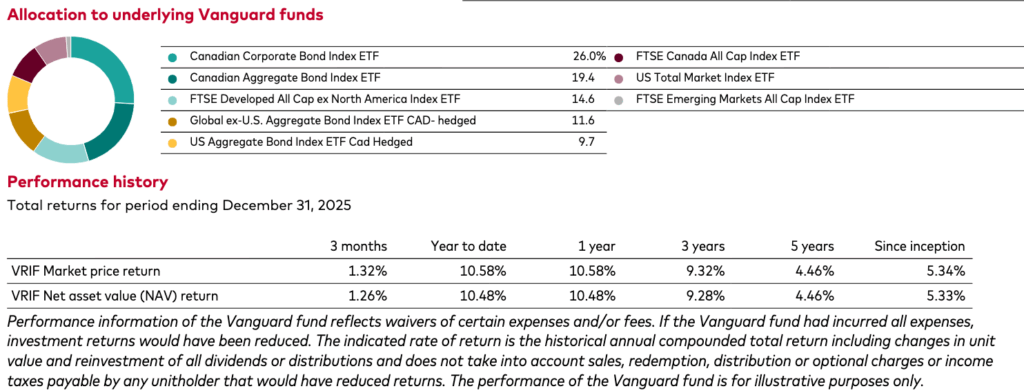
Semi-retired Globe & Mail financial columnist Rob Carrick mentioned this in his bi-weekly column late in January: “A big believer in bonds is the investing giant Vanguard, which last year took an unusual stance in suggesting a portfolio of 70% bonds and 30% stocks. The underlying thinking here is sound: stocks have soared and bonds are undervalued.”
I’d also noticed various YouTube videos from Vanguard’s U.S. parent evince similar caution—a retrenchment from the big U.S. Growth mega cap stocks in favor of other developed and emerging economies around the world.
On January 21st, Vanguard Canada held a media briefing of two of its top economists at its Toronto headquarters, which allowed me to ask about these perceptions of its rising caution. (You can find at least two news stories on the web filed shortly after the event by Bloomberg News and Investment Executive.)
4% targeted payout in line with Bengen’s famous 4% rule
Our focus here is VRIF. The original news release emphasized the objective is to provide income-seeking investors with a “targeted 4% annual payout.” That happens to be in line with William Bengen’s famous 4% rule, which is “fine with me,” as I quipped at the media briefing.
In response to my query, Vanguard Canada spokesman Matthew Gierasimczuk said VRIF’s asset allocation “varies over time” but the goal is the targeted 4% return: Vanguard sees a “more optimistic outlook on bonds and fixed income.”
Kevin Khang, Vanguard’s head of global economic research reiterated that the ETF seeks to fund a “certain level of payout. Bonds, in our view, can achieve the desired certain level of payout” and “the U.S. stock market is pretty expensive for obvious reasons.” After the Great Financial Crisis, bonds didn’t pay much “but now they are reasonably valued: relative to inflation they are paying a decent real return.”
For this column I was subsequently referred to Aime Bwakira, Head of Product for Vanguard Canada. In my view, the rationale for VRIF’s high fixed-income exposure appears to be one of not taking more risk than you need to take, an eminently reasonable stance that is apt for the retirees to which VRIF caters.
Bwakira confirmed Vanguard “has been leaning more heavily toward bonds—particularly higher quality and corporate bonds—than in past years while staying within its equity guardrails” of a minimum 30% and maximum 60%. This positioning “reflects the current environment and the results of our capital markets projections.”
Three-fold rationale for raising proportion of Fixed Income
The rationale is three-fold.
First is higher interest rates. Bonds—especially corporate bonds—are paying more than they did for many years following the 2008 Great Financial Crisis (GFC): “This makes them well-suited to support VRIF’s 4% income target without taking on unnecessary stock-market risk.” VRIF includes corporate bond exposure specifically to help enhance yield for investors.
Second, given today’s market outlook, the fund’s model has shifted toward fixed income because bonds “currently provide a more favourable balance of expected return and risk.” I was also referred to Vanguard’s current VCMM 10-year projections (VCMM = Vanguard Capital Markets Model) for various asset classes. It’s also published in the US for US investors Vanguard Capital Markets Model® forecasts.
Dated January 22, 2026, the document states: “Even at current stretched valuations, rising earnings growth could provide momentum for stocks in the near term. However, our conviction is growing stronger that long-term prospects for U.S. equities are subdued. Our model anticipates annualized returns of about 3.9% to 5.9% over the next 10 years.” It adds, “Our muted long-term return projection for U.S. equities is entirely consistent with our more bullish prospects for an AI-led U.S. economic boom.”
