

For many, wintering in the U.S. isn’t just a trip: it’s a lifestyle and an investment. And Donald Trump’s trade war is forcing some difficult choices
Article content
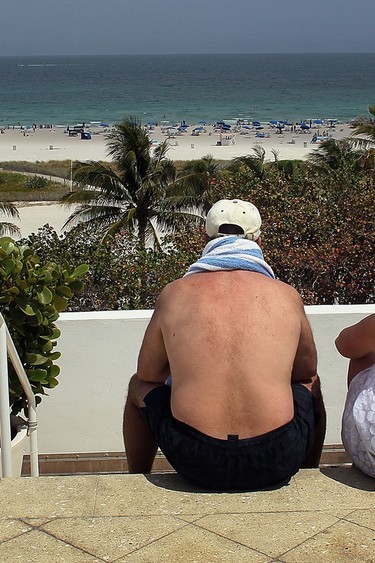
Rick, a retired accountant from Vernon, B.C., has been coming to California for 17 years.
But closing in on 80 years of age, he has been reconsidering that ritual. He doesn’t like the political climate in the United States and he also worries about how Canadians will be accepted.
Article content
Article content
He would probably sell his place in Palm Desert if he could rent it back when he wanted.
Advertisement 2

Article content
“If I were making a financial decision strictly, I would sell,” he said. But there’s a catch. “The emotion gets into it. We love being here, as do all of our Canadian and American friends.”

Top Stories
Article content
Rick, who didn’t want his last name used over fears about repercussions travelling to the U.S., is one of about a million Canadian snowbirds who could be forgiven for feeling a little trapped these days.
Amid boycotts and anger over the trade war and U.S. President Donald Trump‘s musing about making Canada the 51st state, many are feeling forced to choose between their country and their winter residences — second homes full of family, friends and fond memories.
“We struggled with it and talked about it probably daily for months before we came back down,” Rick said.
Other Canadians, not tied down by the financial and emotional attachments snowbirds face, are making the opposite choice.
Statistics Canada data showed trips to the United States plunged 21.6 per cent year over year in the second quarter. Meanwhile, Canadians took 99.3 million domestic trips, up 8.5 per cent from the same period a year earlier.
Article content
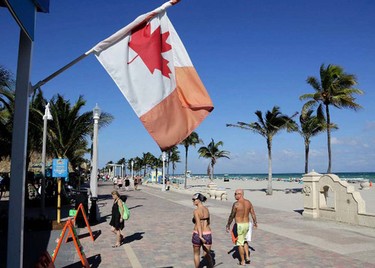
The fourth quarter of this year and the rest of the winter will test Canadians’ will: there is nowhere north of the border that can compare with American sunbelt destinations such as Florida, California and Arizona, where retirees have long flocked to avoid winter.
Article content
Stephen Fine, founder of Snowbird Advisor and a lawyer by training, said that while the sentiment against travel to the United States started in February, the full impact is only hitting now.
“This is the first year we can tell what is happening,” he said.
Snowbirds still heading south
A recent survey of Fine’s members, based on 4,000 responses, found that last year 82 per cent of snowbirds went to the United States, six per cent stayed home, and the balance of 12 per cent went to international destinations.
We thought that more people might be staying home this year, but that’s not the case. They’re going anyway
Stephen Fine, founder of Snowbird Advisor
The same members were asked where they planned to go this year, and 70 per cent said the U.S., seven per cent said stay home, and 23 per cent said international.
“We thought that more people might be staying home this year, but that’s not the case. They’re going anyway,” said Fine.
The difference is being picked up by international destinations, with top choices for his members are Mexico, Spain, Portugal, Costa Rica and the Caribbean.
Fine said the 15 per cent drop in U.S. travel by snowbirds is a lot less than in other travel segments, noting that in the general population, the decline in U.S. travel is more likely 25 per cent to 40 per cent.
“I think there are several factors,” he said. “The top three factors are: Number one, people own property; they’re not going to leave it vacant for the winter to go somewhere else. That doesn’t make sense financially for a lot of people.”
Article content
But another is that 70 per cent of snowbird residents drive to the United States, and other warm-weather destinations are not that accessible. Driving not only saves on airfare but also on vehicle rental, which can cost thousands over the winter.
Fine said the third key factor is that snowbirds are a different demographic.
“It’s a lifestyle,” he said. “They’re going to see their friends. They have communities down there. They’re spending months at a time down there. And for them to pick up and leave for somewhere else is a little more difficult. If you’re going away for a week or a weekend, you can pretty much go anywhere.”
Difficult decisions
Still, the decision to continue wintering in the United States is weighing heavily on Canadians, and some are electing to rent before making a major commitment.
Kym Dias, a California realtor originally from British Columbia, said people who own are coming back down, but that is because of the existing investment.
“Some of them have even said to me, ‘If I didn’t own, I would be making a totally different decision here,” she said.
Still, she is working with a seller from Vancouver today who isn’t political at all, but whose wife is lamenting that none of her friends will visit her in the United States this winter.
Article content
“A lot of their friends rent. So she has nobody to hang out with. They’re not going to come down for four years. She said, ‘I’m not sitting here while my husband golfs.’ Now they are selling,” said Dias.
She figures once some of her older Canadian clients sell, many closer to 80, they will be gone for good.
“They’re probably not going to come back down here and buy another place,” she said. “Quite a few of them are, like, ‘We’re just going to go travel. We just don’t want to be locked down anymore.’ They are going to do something else.”
On the U.S. East Coast, Hollywood Beach, 30 kilometres north of Miami, has long been known for playing host to throngs of French Canadians, and the question there is whether they will return this year.
Article content

Tom Vaskovic, a former Torontonian who moved to South Florida almost 25 years ago and now owns an ice cream stand on the beach called Surf N’ Spray, has seen tourism ebb and flow in his time. He admits last year business did “take a little dive,” so he’s cautious about what comes next.
“There are not as many people from Quebec as there used to be,” he said, adding that while there is something to the boycott talk, customers who are still coming down appear more concerned about inflation.
Article content
“The difference in the dollar is one thing, but the inflation down here makes it seem like the prices are even higher,” he said. “I can’t blame them, but there is also a lot of media against the United States.”
How much do boycotts hurt U.S. tourism?
A big question for boycott proponents is how much Americans really care about Canadians travelling to the United States. Canada cannot sink the American travel industry, but a boycott could hurt.
The U.S. Travel Association said Canadians were the top visitors to America in 2024, with 20.4 million trips, generating US$20.5 billion in spending and supporting 140,000 American jobs. A 10 per cent reduction in Canadian travel, which is already happening, could mean two million fewer visits, or US$2.1 billion in lost spending, and 14,000 job losses.
Those same snowbirds and Canadian buyers will have less of an impact on a U.S. housing market that had US$2.2 trillion in existing sales in 2024. Nevertheless, Canadians were the second largest international buyers of residential real estate in the U.S. last year at US$6.2 billion, only slightly behind the Chinese, and in tourist areas their absence is at least being noticed.
I’m going to be very honest with you. We used to get a lot more Canadians
Isabella Holguin, director of sales at St. Regis condo development
At the two-tower project known as the St. Regis in Sunny Isles, a city located on a barrier island in northeast Miami-Dade with 62 storeys of luxury condos that start at US$5 million, the director of sales, Isabella Holguin, laments the loss of Canadians. But she doesn’t sound too worried.
Article content
“I just sold to a guy from Suriname. The whole 24th floor, all four units,” she said.
Holguin said the complex’s south tower with 170 units, set to deliver in 2028, is sold out, while its north tower has only 150 units to accommodate buyers clamouring for bigger and more expensive units.
One customer walked in from the beach and signed all the paperwork to buy a unit at the complex, which is selling for an average of US$2,750 per square foot. And unlike the friendly down payment market in Toronto’s condo scene, customers need to have 50 per cent down, a standard driven by the 2008 housing crash, south of the border.
“We are getting money from a lot of countries, but mainly the U.S. I’m going to be very honest with you. We used to get a lot more Canadians,” Holguin said.
This year, she’s had only three Canadians purchase in the newer north tower. The original south tower saw 11 of its 170 units bought by Canadians.
“Part of this is the dollar, it’s very expensive for you guys,” she said, noting that in the past her group would do marketing shows in Montreal and Toronto to sell.
Article content
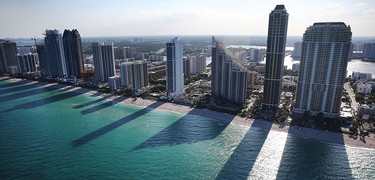
It’s the opposite of COVID times, when Canadians flocked to South Florida, driven in part by a state that had virtually no lockdowns throughout the pandemic.
Article content
“A lot of Canadians came. Everybody wanted to be here. A big factor was that we were open. You came down here, and you didn’t even know COVID was happening. People were free here. So they didn’t care about whether it was too expensive. They only cared about their freedom,” Holguin said.
The Canadians are gone and others have filled the gap.
“For me now, it’s Americans. We can sell to Brazilians, Mexicans,” she said. “I can’t change tariffs; it is what it is.”
New requirements for snowbirds
Evan Rachkovsky, director of research and communications for the Canadian Snowbird Association, said 70 per cent of Canadian snowbirds go to Florida, so the state will bear the brunt of any decline.
“I think the political discourse is having a negative effect because snowbirds have been caught up in that with this new registration requirement,” he said, noting that visitors must now check in with the U.S. government for stays of 30 days or longer.
Both Rachkovsky and Fine, the snowbird adviser, suggest the new requirements are mostly about paperwork, but they are a new reality Canadians will have to get used to in much of the world.
“People are concerned about it, but it is not a particularly difficult process,” said Fine, adding that biometrics or fingerprinting are becoming common for many countries.
Article content
“I think it just doesn’t sit well with people because of everything else that’s going on. But the truth is, the U.S. isn’t unique in doing this, and the world is heading in that direction. And we will probably do it in Canada.”
Article content
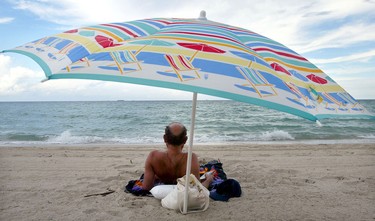
It may be the new norm, but for people like Bill Cherniatenski, who just retired after four-and-a-half decades working in procurement for one of Canada’s largest grocery market chains, it has him thinking twice about his next move.
“We decided against our own beliefs that we are going to go down for February this year, only,” said Cherniatenski, who had owned a condo in Myrtle Beach, South Carolina, during his working years but sold it during the pandemic because the timing was right and so was the price.
He wanted to investigate an even warmer climate further south, but the political discourse got in the way. Now he’s taking baby steps and renting in Panama City, Florida, this year, not far from the state capital of Tallahassee, after a very friendly landlord convinced him to come and gave him an even friendlier rate of US$1,700 for an oceanfront unit in a complex with two pools and hot tubs.
“Last year, I said no because of the political environment,” said Cherniatenski, who readily admits the weak Canadian dollar also kept him home.
Article content
He and his wife, who live just outside Toronto, were really on the fence this year too, but the landlord could not have been more welcoming.
How to handle the increased tensions with the U.S. was a topic of conversation among his neighbours, with many considering the trade war’s impact on their retirement plans.
“I talked to other people, and they said, ‘You know, you worked 45 years for this moment, why let one person in the States change your life?’” he said.
His other fear was how Americans would treat Canadians south of the border but a neighbour put him at ease.
“He said they roll out the red carpet for Canadians, and they are apologetic,” he said.
But don’t get the idea that he is fully committed to the United States. Cherniatenski is part of the new wave of Canadian retirees who will have to be won over, as they are now making choices that could impact their next decade or two of winter travelling.
“We just came back from the Dominican,” he said, noting renting in Florida lets him try out his options.
He is less fearful of crossing the border and thinks the rules are pretty much the same in practice.
“This is the States. Nothing’s changed at the border. Keep your mouth shut. Only speak when asked,” said Cherniatenski, who admits in the back of his mind he does worry about some immigration hassle.
But he has his line in the sand where he won’t return to America.
“If they mistreat Canadians, if they don’t respect us, I’d say, ‘Screw you guys.’”
• Email: gmarr@postmedia.com
Article content
